Verified > 99% Lab-grade Peptides
Air Conditioning Peptide Testing Laboratories Third-party Peptide Evaluation
For scientists, obtaining validated peptides isn't just a procedure-- it's the structure of reliable experiments and study reproducibility. Poor-quality peptides (those with undetected pollutants, inaccurate series, or weakened parts) can result in misleading data and irreproducible outcomes. In fact, proteins and peptides are among the most widely used laboratory reagents, yet research studies have shown that their top quality is commonly poor, resulting in poor information reproducibility. Starting with appropriate research laboratory validation is therefore an essential part of a researcher's quality assurance operations.
- BOC Sciences provides multi-batch contrast analysis to help customers develop basic material top quality standards and guarantee consistency.
- These counterions aren't "pollutants" in the HPLC sense-- they don't show up as different optimals-- however they do add to the total mass of the powder.
- It is a graph with time on the horizontal axis and detector response, generally UV absorbance, on the vertical axis.
- By using a qualified third-party lab, peptide makers or scientists guarantee an honest and properly documented assessment of high quality, which is exactly what inspectors seek.
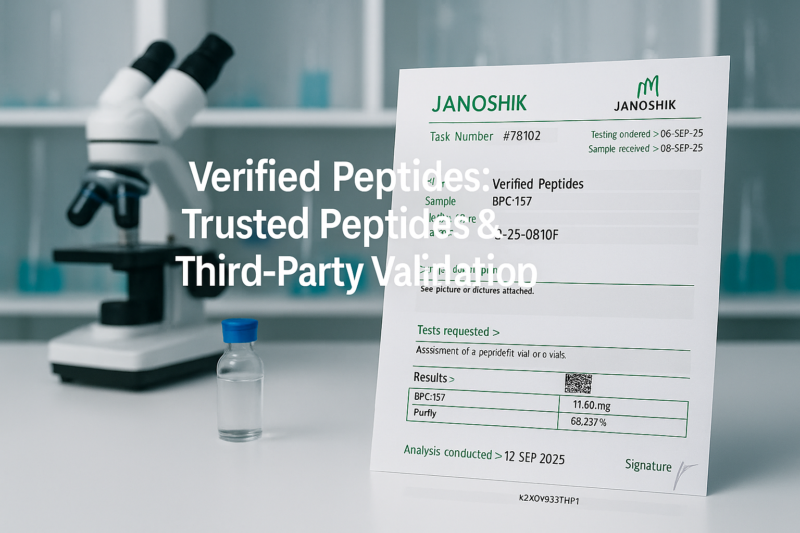
Recognizing Peptide Purity Testing
HPLC can support cases about chromatographic pureness, contamination top problem, and destruction trends when the approach is appropriate and the chromatogram is offered. If a peptide is re-tested after storage space anxiety, HPLC can reveal whether brand-new contamination optimals have appeared or whether the main top location has actually decreased. This links directly with handling topics such as peptide storage and peptide reconstitution. As an examples of product-level context, compare the expected PT-141 masses for Retatrutide, BPC-157, and Semaglutide.Can Hplc Find Peptide Degradation?
Either can be appropriate, but third-party testing is the gold criterion for research-grade materials. Residual solvents, such as DMF, acetonitrile, or DMSO, are measured using gas chromatography (GC) approaches. These solvents can influence peptide capability, so accurate quantification is necessary to make certain pureness and prevent contamination in experimental settings. Peptide stability is examined under numerous conditions to ensure integrity throughout research study and item growth.What The Pollutants Actually Are
Gauging peptide pureness is normally finished with logical high-performance fluid chromatography (HPLC), usually combined with mass spectrometry (MS) for identity confirmation. These analytical strategies are conventional in peptide quality assurance and you will certainly usually obtain HPLC and MS information with a study peptide order. The primary logical techniques for peptides include liquid chromatography (LC), normally HPLC, incorporated with mass spectrometry (MS) for exact molecular weight determination and Go to this website series recognition. 